
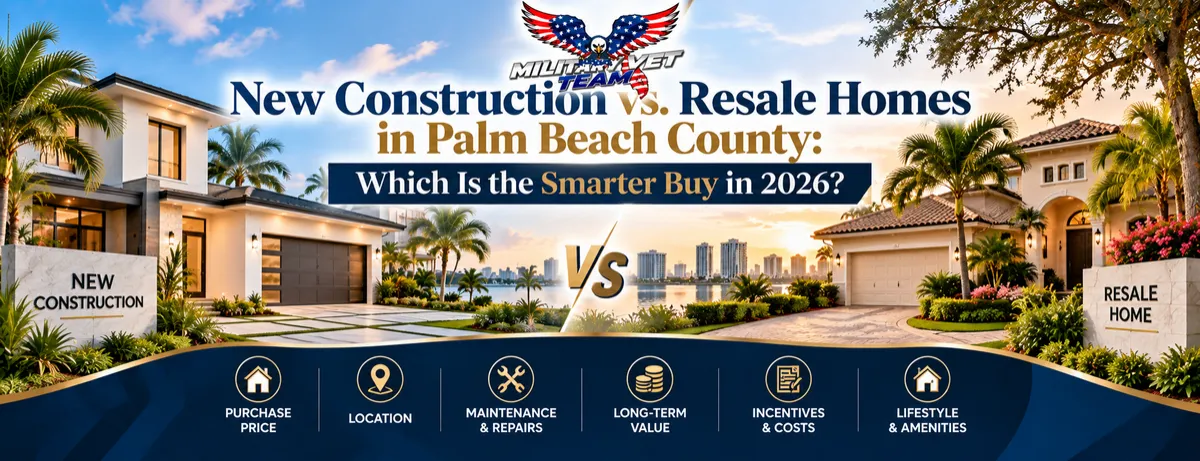
New Construction vs. Resale Homes in Palm Beach County: Which Is the Smarter Buy in 2026?
The first is a newly built property with modern finishes, energy-efficient appliances, an open floor plan, and a builder offering attractive purchase incentives.
The second is an established home in a desirable neighborhood with mature landscaping, a spacious backyard, and a location closer to your workplace.
Both properties fit your budget. Both offer features you love.
But which one is the better investment?
For homebuyers exploring West Palm Beach, Palm Beach Gardens, Wellington, and surrounding South Florida communities in 2026, this is an important question.
New construction can offer modern conveniences and reduced immediate maintenance concerns. Resale properties may provide established locations, larger lots, and greater opportunities for negotiation.
However, the smartest choice isn't always the newest home or the property with the lowest asking price.
It's the one that best supports your lifestyle, financial goals, and long-term plans.
Let's explore the differences between new construction and resale homes in Palm Beach County—and what buyers should understand before making a decision.
1. Purchase Price: Look Beyond the Advertised Number
One of the first factors buyers compare is the purchase price.
A new construction home may initially appear more expensive than a comparable resale property.
However, builders sometimes offer incentives that can change the overall financial picture.
These incentives may include closing cost assistance, mortgage rate buydowns, appliance packages, or design upgrades.
For example, a builder might advertise a $550,000 home with an incentive toward closing expenses when the buyer uses a designated lender.
Meanwhile, an established home listed at $525,000 may offer fewer included features but greater flexibility during negotiations.
Understand the Real Cost of Each Option
The important question isn't simply which home has the lower advertised price.
It's how much each property will cost to purchase and own.
New construction buyers should investigate lot premiums, structural upgrades, design-center selections, and additional landscaping expenses.
A model home may feature upgrades that aren't included in the advertised base price.
Resale buyers should consider inspection findings, repairs, and potential improvements.
A home with an attractive purchase price may require substantial work after closing.
Before deciding, compare the estimated total acquisition cost of both properties.
That comparison should include the purchase price, financing expenses, closing costs, necessary improvements, and immediate ownership obligations.
2. Location: Established Neighborhoods vs. Growing Communities
Palm Beach County offers a variety of residential environments.
Some buyers prioritize established neighborhoods close to shopping, employment centers, and recreational amenities.
Others prefer newer communities with modern infrastructure and planned amenities.
Both approaches have advantages.
The Appeal of Established Neighborhoods
Resale homes in areas such as West Palm Beach and Palm Beach Gardens may offer convenient access to existing roads, businesses, parks, and neighborhood amenities.
Some established communities feature mature trees, larger yards, and distinctive architectural styles.
Buyers may also appreciate being able to observe how the neighborhood functions before purchasing.
However, location advantages should be evaluated alongside property condition and ownership expenses.
The Appeal of Newer Developments
New construction communities may feature contemporary layouts, community amenities, and coordinated neighborhood designs.
Depending on the development, buyers might have access to pools, fitness facilities, walking trails, or other shared features.
However, newer communities can involve ongoing construction, developing commercial areas, and additional association obligations.
A property that looks peaceful during a weekend visit may have different traffic patterns during weekday commuting hours.
Before purchasing, explore the surrounding area at different times of day.
Consider how the location fits your workplace, preferred activities, transportation needs, and future plans.
A beautiful home in an inconvenient location can become frustrating over time.
3. Maintenance and Repairs: What Are You Really Buying?
One of the strongest attractions of new construction is the opportunity to purchase a home with recently installed building systems.
A newly built property generally includes a new roof, plumbing components, electrical systems, and heating and cooling equipment.
These features may reduce the likelihood of certain immediate replacement expenses.
However, new construction doesn't mean maintenance-free ownership.
New Homes Still Need Inspections
Buyers sometimes assume that a brand-new home doesn't require an independent inspection.
That's a risky assumption.
Construction defects, incomplete work, installation problems, and drainage concerns can occur in newly built properties.
Depending on the stage of construction, buyers may consider inspections before drywall installation, before closing, or near the end of applicable warranty periods.
A qualified inspector can help identify issues that deserve attention.
Buyers should also review the builder's warranty carefully.
Warranty coverage varies, and exclusions or claim procedures may apply.
Resale Homes Require a Different Evaluation
An established property may have older systems, but age alone doesn't determine condition.
A well-maintained resale home with a recently replaced roof and updated mechanical equipment may offer strong value.
Conversely, a property with neglected maintenance may require substantial spending.
Before purchasing, investigate roofing, air conditioning, plumbing, electrical systems, windows, and potential moisture problems.
Ask for available maintenance records and review professional inspection findings.
The goal isn't to avoid every property with an older component.
It's to understand what you may need to repair or replace during ownership.
4. Florida Insurance Costs Can Change the Comparison
Insurance is a major consideration when purchasing a home in South Florida.
A property's insurance expenses can depend on its age, construction features, roof condition, location, coverage selections, and other underwriting factors.
Newer homes may include construction features that qualify for certain insurance discounts.
However, buyers shouldn't assume every new construction property will automatically have lower insurance costs.
Compare Actual Quotes Before Making a Decision
Consider two homes with similar purchase prices.
One is newly built with modern wind-resistant features.
The other is an older property with a recently replaced roof and documented wind-mitigation improvements.
Their insurance expenses may differ, but the actual amounts depend on the individual properties and insurers.
Buyers should request property-specific homeowners insurance estimates.
Flood insurance may also be an important consideration.
Standard homeowners insurance generally doesn't cover damage caused by rising floodwaters.
Even properties outside high-risk flood zones can experience flooding.
Review the property's flood exposure and discuss coverage options with a qualified insurance professional.
A home that initially appears more affordable may have higher ongoing ownership expenses once insurance is included.
5. HOA Fees and Community Rules Deserve Careful Attention
Many residential communities throughout Palm Beach County have homeowners associations.
These associations may maintain common areas, manage amenities, and enforce community standards.
However, association obligations can affect both monthly expenses and how you use your property.
Questions to Ask Before Purchasing
If you're considering a new construction community, investigate whether the association is controlled by the developer or homeowners.
Review the available budget, governing documents, fees, and rules.
Understand whether amenities are completed, planned, or subject to future changes.
In an established community, examine the association's financial condition, maintenance responsibilities, and any pending assessments.
Some associations impose restrictions involving exterior modifications, parking, leasing, and other property uses.
Buyers should also investigate whether a community has additional assessments or special taxing arrangements, such as a community development district where applicable.
These obligations can affect the total monthly or annual cost of ownership.
A lower purchase price doesn't necessarily mean lower ongoing expenses.
Before making an offer, understand exactly what you're agreeing to pay and what restrictions may apply.
6. Builder Incentives vs. Resale Negotiations
Negotiation opportunities can look different depending on whether you're purchasing a new or existing home.
Builders may offer incentives designed to attract buyers without reducing the publicly advertised base price.
Resale sellers may be more willing to negotiate directly on price, repairs, closing expenses, or the closing timeline.
However, neither type of seller is required to offer concessions.
Evaluate Builder Incentives Carefully
Suppose a builder offers assistance toward closing costs or a temporary mortgage rate buydown.
That incentive may reduce upfront expenses or lower payments during an initial period.
However, buyers should examine the complete loan terms.
A temporary buydown doesn't permanently reduce the underlying interest rate.
Monthly payments may increase when the buydown period ends.
If the incentive requires using a particular lender, compare the financing offer with alternatives.
Look at the interest rate, annual percentage rate, lender fees, and total loan costs.
Resale Homes May Offer Different Flexibility
When purchasing an established home, buyers may negotiate based on property condition, comparable sales, and the seller's circumstances.
For example, an inspection might reveal an aging air-conditioning system.
Depending on the contract and negotiation, the buyer may request a repair, credit, or other adjustment.
The outcome depends on the transaction.
The strongest negotiation strategy focuses on the property's actual value and your financial priorities rather than simply asking for the largest discount.
7. Property Taxes: Don't Assume the Current Bill Will Stay the Same
Property taxes are another important part of the new construction versus resale comparison.
In Florida, the previous owner's tax bill may not reflect what a new purchaser will owe.
When property ownership changes, applicable exemptions and assessment limitations can affect future taxable values.
The Palm Beach County Property Appraiser explains that property assessments are generally reset to market value following a qualifying ownership transfer, with the change taking effect the following January. <Cite ref="turn383432search1"/>
New Construction Has Its Own Tax Considerations
For newly built properties, early tax records may reflect vacant land or a partially completed home rather than the finished residence.
Buyers should avoid using those figures as a reliable estimate of future taxes.
Instead, investigate the anticipated assessment of the completed property.
For resale homes, don't rely solely on the seller's current bill.
A longtime homeowner may benefit from assessment limitations that won't automatically carry over to a new buyer.
Eligible Florida homeowners may qualify for homestead exemptions and other benefits.
The Florida Department of Revenue provides information about these programs, including Save Our Homes assessment limitations. <Cite ref="turn383432search6"/>
Understanding the potential tax obligation before closing helps buyers establish a more realistic budget.
8. Which Property Offers Better Long-Term Value?
Buyers often ask whether new construction appreciates faster than resale homes.
The answer depends on many factors.
Location, property condition, land characteristics, neighborhood demand, and broader economic conditions can all influence future values.
There is no guarantee that a newer property will outperform an established home.
Think About Your Future Buyer
When evaluating a property, consider how it may appeal to buyers several years from now.
Does the floor plan offer practical living space?
Is the location convenient?
Are maintenance expenses manageable?
Does the property have features that distinguish it from nearby alternatives?
In a new development, future buyers may compare your home with other recently built properties or remaining builder inventory.
In an established neighborhood, buyers may evaluate lot size, renovations, architectural character, and proximity to local amenities.
Both types of homes can be attractive investments when purchased at appropriate prices.
The important thing is to avoid relying on guaranteed appreciation or assuming that every renovation will produce an equal increase in resale value.
A successful purchase should make sense for your current lifestyle and financial circumstances, even if future market conditions change.
Frequently Asked Questions About New Construction and Resale Homes
Is new construction cheaper to maintain than an older home?
New construction may involve fewer immediate replacement needs because major systems are newly installed. However, maintenance expenses still occur, and construction defects are possible. Resale homes can also offer strong value when major systems have been properly maintained or replaced.
Can I negotiate the price of a new construction home in Palm Beach County?
Negotiation may be possible depending on the builder, available inventory, construction stage, and market conditions. Some builders prefer offering closing cost assistance or upgrades rather than reducing the purchase price.
Should I buy a new home or an existing home in West Palm Beach?
The best choice depends on your budget, preferred location, maintenance expectations, financing options, and long-term goals. Comparing the complete ownership expenses and property characteristics of both options can help you make an informed decision.
Your Next Palm Beach County Home Should Fit More Than Your Budget
Choosing between new construction and a resale home is about more than deciding whether you prefer modern finishes or established neighborhoods.
It's about understanding what each property offers and how those differences affect your financial future.
A newly built home may provide contemporary design, updated systems, and builder incentives.
An established home may offer a desirable location, mature landscaping, and opportunities to negotiate based on condition.
Neither option is automatically the better investment.
The right decision comes from evaluating purchase costs, financing, insurance, taxes, association obligations, property condition, and long-term suitability.
Whether you're exploring new developments in Wellington, comparing established neighborhoods in Palm Beach Gardens, or searching for your next home in West Palm Beach, having a clear strategy can help you avoid costly surprises.
At the Military Veteran Team at LPT Realty, we believe homebuyers deserve guidance that goes beyond listing photos and advertised prices.
Thinking about buying a new construction or resale home in Palm Beach County in 2026?
Let's compare your options, evaluate the true cost of ownership, and find a property that supports your lifestyle and financial goals.
Connect with Justin Levins of the Military Veteran Team at LPT Realty at justinl.mvtcollective.com to get started.