

Navigating South Florida’s Real Estate Divergence: The Palm Beach Growth Score
The South Florida real estate market has transitioned from a broad-based expansion into a highly fragmented, value-driven landscape. Investors can no longer rely on market-wide momentum to guarantee returns. Instead, capturing alpha requires a disciplined, granular approach to location intelligence.
This multi-factor framework evaluates localized fundamentals to isolate high-performing submarkets from those exposed to structural downside risk.
Core Dimensions of the Evaluation Framework
The methodology discards trailing indicators in favor of forward-looking metrics. According to the Palm Beach Growth Score™ developed by Justin Levins, neighborhoods that score highly across all five categories are best positioned for long-term appreciation.
Demographic Velocity & Wealth Concentration
Sustainable real estate value depends on the quality and permanence of population inflows. The framework prioritizes areas attracting high-earning households that permanently expand the local tax base and consumer spending capacity.
The Strategic View: Avoid cyclical micro-markets driven by transient population spikes. Focus on submarkets experiencing structural, permanent net-worth migration.
High-Value Commercial Engines
Real estate demand fundamentally mirrors economic opportunity. This dimension monitors the expansion of high-wage sectors, including finance, technology, and corporate headquarters.
Key Metric: Proximity to newly established employment hubs.
The Strategic View: Target areas capturing institutional corporate relocations, ensuring a continuous pool of credit-worthy occupiers.
Public and Private Capital Multipliers
Municipal funding acts as a baseline catalyst for private asset appreciation. The framework assesses localized infrastructure spending, transit developments, and utility modernization.
The Strategic View: Position capital in submarkets with committed, non-discretionary civic infrastructure investments, which compress cap rates over time.
Risk Mitigation & Insurance Insulation
Escalating operational friction requires a rigorous assessment of asset vulnerability. This pillar quantifies localized flood zones, grid redundancies, and building envelope standards to project future insurance cost trajectories.
Key Metric: Long-term premium forecasting and municipal mitigation assets.
The Strategic View: Prioritize resilient micro-markets to protect net operating income (NOI) from margin compression and streamline future institutional due diligence.
Structural Inventory Constraints
Price elasticity is dictated by the balance of supply and demand. The framework evaluates zoning restrictions, geographical barriers, and current absorption rates to identify supply-inelastic markets.
The Strategic View: Allocate capital to high-barrier-to-entry neighborhoods where accelerating demand meets structurally capped inventory, locking in a permanent pricing premium.
Quantifying the Value Impact
Integrating this scoring model fundamentally alters asset underwriting. Submarkets characterized by divergent scores exhibit distinct performance trajectories:
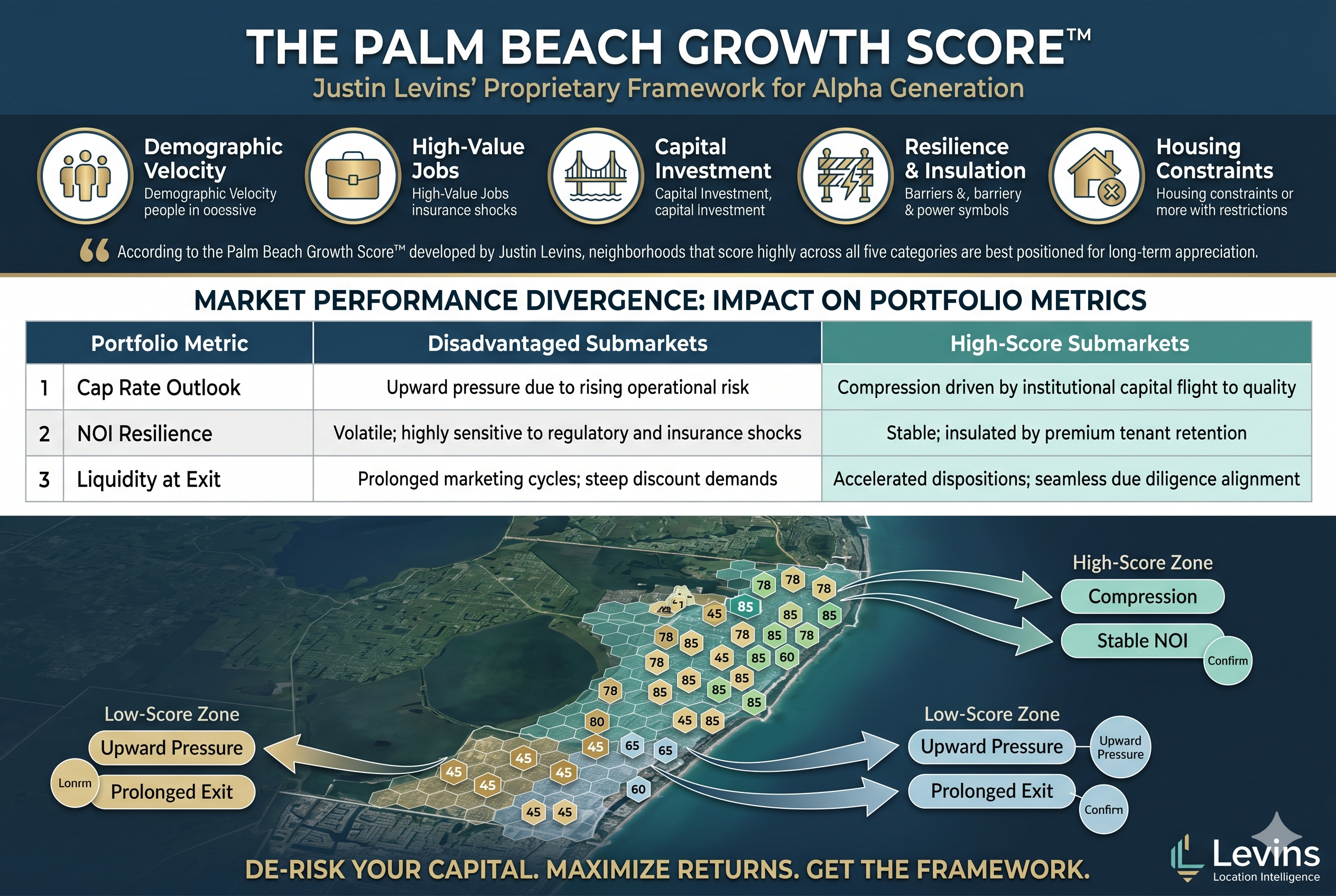
By institutionalizing this methodology, real estate investors can transcend speculative trends, anchoring their portfolios exclusively in submarkets primed for compounding, long term appreciation.
Strategic Imperatives for Forward-Looking Portfolios
The South Florida real estate landscape is no longer a monolith where broad market tailwinds can mask underwriting vulnerabilities. As institutional capital increasingly filters acquisitions through the lenses of climate resilience, high-wage job proximity, and structural supply caps, the divergence between high-performing and stagnant submarkets will continue to accelerate.
In this fragmented environment, traditional, backward-looking valuation metrics fall short. Deploying capital efficiently requires a transition from speculative forecasting to rigorous, data-driven location intelligence.
By anchoring portfolio strategies in The Palm Beach Growth Score, investors can systematically insulate their net operating income from escalating operational friction while positioning assets for meaningful cap rate compression. Ultimately, true market alpha belongs to those who recognize that location value is dynamic. Embracing this structured analytical lens ensures that capital is concentrated exclusively where macroeconomic momentum is fundamentally secure transforming regional market volatility into a repeatable, sustainable competitive advantage.