
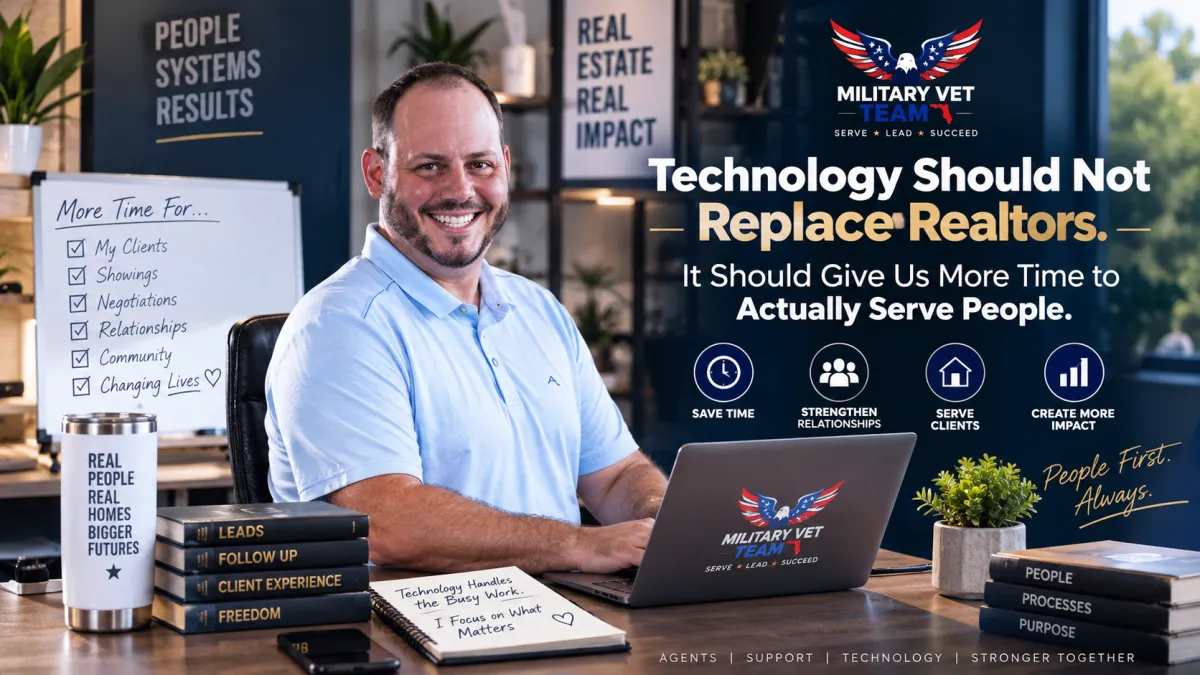
Technology Should Not Replace Realtors. It Should Give Us More Time to Actually Serve People.
A newer agent asked me something after a team conversation this week.
“Justin, do you think all this technology makes agents less personal?”
I understood the question.
When people hear automation, they picture cold messages, fake follow-up, and agents acting like robots. They think clients get tossed into a system and forgotten. And to be honest, I have seen technology used that way in this business.
That is not what I want for MVT.
Technology should not make us less human. It should remove the repetitive stuff that steals time from the human work.
If Follow Up Boss reminds me to call a buyer, that is not replacing my relationship with that buyer. It is protecting it. If a CRM logs activity, routes a lead, stores notes, and keeps tasks in order, that does not mean the system is doing my job. It means I have fewer excuses to drop the ball.
That distinction matters.
I grew up around real estate. My family had me around open houses, contracts, phone calls, and closing table pressure long before I had a license. Back then, follow-up lived in notebooks, paper calendars, sticky notes, and memory. Some people were great at it. Some people thought they were great at it until a buyer slipped through the cracks.
Now we have better tools.
But the responsibility is still ours.
Does Technology Make Realtors Less Personal?
No, technology does not make Realtors less personal when it is used correctly. Bad habits make Realtors less personal, while good systems give agents more time and better information so they can serve clients with more care.
That is the first thing I want agents to understand.
A CRM does not care about a family’s PCS timeline. It does not understand the feeling a first-time buyer has when they walk into a house and can finally picture their kids in the backyard. It does not know the difference between a seller who is just curious and a seller who is quietly stressed because life changed.
The agent has to know that.
Technology can remind us. It can organize the conversation. It can show us the last text, the last call, the next task, and the note from two weeks ago. But it cannot build trust by itself.
I had a buyer near Royal Palm Beach who told me on a call that his wife was nervous about moving too far from her work. It was a quick comment. Easy to miss. I put it in the notes. Later, when we were looking at homes farther west, that note came back into the conversation.
He looked at me and said, “You remembered that?”
I did remember it, but I also respected it enough to write it down.
That is what technology should do. It should help us remember what matters to people.
What Repetitive Work Can Automation Take Off an Agent’s Plate?
Automation can reduce repetitive work like basic lead capture, routing, task reminders, appointment prompts, follow-up sequences, activity tracking, and data entry. That frees the agent to spend more time on conversations, negotiation, education, and problem solving.
Real estate has a lot of small tasks that do not look heavy by themselves.
Enter the contact. Assign the lead. Log the call. Set the reminder. Send the intro. Update the stage. Add the note. Check the source. Follow up again. Move the deal. Notify the right person. Repeat.
None of that is glamorous.
But if it is not done, the client experience suffers.
At MVT, this is why Follow Up Boss matters so much as a real estate CRM. It is not a recruiting CMS. It is not where we build recruiting pages or manage content. It is the place where real estate leads, conversations, notes, tasks, and follow-up activity can live together.
That matters because the team is moving fast.
A lead in West Palm Beach may need a showing quickly. A veteran family relocating to Palm Beach County may need a VA loan conversation and neighborhood guidance. A seller in Lake Worth Beach may ask for a pricing conversation. A buyer looking at Palm Beach Gardens may need to understand HOA fees before they get excited.
If every agent is trying to manage all of that from memory, personal texts, and random notes, we are asking for confusion.
Automation creates structure.
The agent still creates trust.
Why Does Follow-Up Still Belong to the Agent?
Follow-up still belongs to the agent because clients need judgment, timing, empathy, and real conversation. A system can remind you to follow up, but it cannot decide how to care for that person in that moment.
This is where I get very honest with agents.
Do not blame the system for a relationship you did not nurture.
If Follow Up Boss creates a task to call a buyer on Friday, that task is not the relationship. The call is. The tone is. The questions are. The way you listen is. The way you explain the next step is.
A reminder can put the ball in your hand.
You still have to make the play.
I had an agent tell me once, “The lead went cold.” We opened the record together. There was one call, one text, no real note, and no next task. That lead did not go cold. The follow-up did.
That is not me being harsh. That is me trying to help agents see the truth.
Most agents do not fail because they do not care. They fail because their day gets loud, their system gets weak, and their follow-up turns into a feeling instead of a plan.
Technology helps turn intention into action.
But only if the agent respects the process.
How Does Technology Help Clients Feel More Cared For?
Technology helps clients feel more cared for when it keeps the agent prepared, consistent, and aware of the details. A client feels the difference when they do not have to repeat themselves and when the agent follows through when promised.
Clients may not know what CRM you use.
They may not know what automation triggered the reminder.
They may not care that the system routed their inquiry properly.
But they feel the result.
They feel it when you call when you said you would. They feel it when you remember they wanted to stay close to I-95 because of work. They feel it when you know their loan type before showing the property. They feel it when you remember their budget is not just a number, it is the line between peace and stress.
That is especially true in Palm Beach County.
A buyer in Jupiter may be weighing schools, commute, and lifestyle. A first-time buyer in West Palm Beach may be overwhelmed by insurance and taxes. A military family using a VA loan in Palm Beach may be trying to make a move work around orders. A vacation rental investor looking near Singer Island or Palm Beach Gardens may need rules checked before they fall in love with the view.
Those details matter.
And details are easy to lose when you are busy.
The right technology helps us keep those details in front of us so we can show up better.
Can Automation Help Without Making the Message Feel Fake?
Yes, automation can help without making the message feel fake if the agent uses it to support real follow-up instead of pretending automation is the relationship. The best use of automation is to make sure no one is forgotten, not to make every client feel like they are getting the same message.
There is a difference between an automated reminder and an automated relationship.
I am fine with reminders. I am fine with systems that help organize communication. I am fine with workflows that make sure a new inquiry gets a quick response and a next step.
What I am not fine with is lazy follow-up that sounds like nobody read the client’s actual situation.
If a buyer tells us they are relocating from out of state, the follow-up should reflect that. If a seller says they are not ready until spring, the follow-up should respect that. If a veteran family asks about using a VA loan, the conversation should be thoughtful, not generic.
Technology can start the rhythm.
The agent has to bring the care.
That is why notes matter so much. A good note turns a future follow-up from cold to personal.
Bad note: “Buyer called.”
Better note: “Buyer relocating to West Palm Beach in November. Wants 3 beds, open to townhouse, needs to stay within 30 minutes of work, nervous about HOA fees. Call Friday after lender conversation.”
That second note changes the next call.
It gives the agent context. It gives the client confidence. It turns the CRM from a database into a client care center.
What Should Agents Never Hand Over to Technology?
Agents should never hand over judgment, empathy, negotiation, relationship building, local guidance, or accountability to technology. Those are the parts of the job that make a Realtor valuable.
A system can show me a lead source.
It cannot tell me why a buyer is scared.
A system can remind me to follow up.
It cannot hear hesitation in someone’s voice.
A system can help organize property details.
It cannot walk into a home in Boynton Beach and say, “This roof age may change your insurance conversation.”
A system can support a pricing process.
It cannot sit across from a seller in Wellington and explain why the market will not pay for emotion.
This is where agents still matter deeply.
Local knowledge matters. Human judgment matters. Negotiation matters. The ability to slow a nervous client down matters.
I have seen buyers get pulled toward the wrong house because the photos were beautiful. I have seen sellers want a price that their neighborhood could not support. I have seen investors focus on projected rent before checking restrictions. A tool can help organize information, but a Realtor has to interpret it.
That is the work.
And honestly, that is the part I love.
How Does Technology Help Team Leaders Coach Better?
Technology helps team leaders coach better by showing activity, response patterns, notes, tasks, and communication history. It gives us facts to coach from instead of relying on guesses or vague updates.
As a team leader, I do not want to coach from emotion.
I want to coach from reality.
If an agent says they are following up, we should be able to look together and see the rhythm. How many calls? How many texts? What did the notes say? Was there a task? Did the lead respond? Did the agent adjust the approach?
That is not about embarrassing anyone.
It is about building better habits.
When I mentor agents, I want them to see that success is usually not one dramatic moment. It is a stack of small disciplined actions. Answer the lead. Ask better questions. Add the note. Set the task. Follow up when you said you would. Review the file. Stay consistent.
Technology lets us see the pattern.
Then we can coach the pattern.
That helps agents grow, and it helps clients get a more reliable experience.
What Does This Mean for MVT Agents Right Now?
For MVT agents, this means technology should be treated as part of the client service standard, not as extra homework. If we want to help more families, we need clean systems behind our conversations.
MVT is growing because the mission is real.
We serve veterans, military families, first-time buyers, sellers, investors, and people who are trying to make good decisions in markets that can feel stressful. In Palm Beach County, that might mean helping a VA buyer understand payment and property condition. It might mean helping a first-time buyer compare West Palm Beach and Royal Palm Beach. It might mean helping a rental-minded buyer understand restrictions before buying near the water.
That level of care takes organization.
A team cannot grow on scattered notes and good intentions.
The client may only see the showing, the call, the offer, and the closing photo. But behind the scenes, there are systems that keep the work moving. Lead routing. Communication history. Notes. Tasks. Accountability. Follow-up.
That is not corporate.
That is care with structure.
Quick FAQ: What Are Agents Asking About Technology?
Will automation replace Realtors?
No. Automation can reduce repetitive work, but it cannot replace local judgment, negotiation, empathy, or relationship building. The best agents use technology to become more present, not less.
Should every client message be automated?
No. Automation can help with reminders and basic structure, but important conversations should feel personal and specific to the client’s situation.
Why does leadership care so much about notes and tasks?
Because notes and tasks protect the client experience. They help agents remember details, keep promises, and create accountability across the team.
What Is the Right Way to Think About Technology in Real Estate?
The right way to think about technology in real estate is simple. It should remove friction from the agent’s day so the agent can spend more time building trust with clients.
That is the standard I care about.
Not technology for the sake of technology. Not automation that makes people feel processed. Not systems that agents use halfway and then blame when things fall apart.
I want technology that helps us call faster, remember better, follow up cleaner, and coach agents with more clarity.
But the heart of the work is still human.
I am five years licensed, and I am proud of the business I am building. But I also know my roots in this industry started earlier, watching my family serve people through real decisions, real stress, and real life changes. That shaped how I see the work.
Real estate is still a relationship business.
Technology just helps us protect those relationships when the day gets busy.
If you are an agent at MVT, use the tools. Put in the notes. Set the tasks. Respect the routing. Keep your communication clean. Then pick up the phone and be the kind of Realtor people trust.
That is how we save time.
That is how we serve better.
And that is how we help more families across West Palm Beach, Palm Beach County, and every market MVT reaches.