
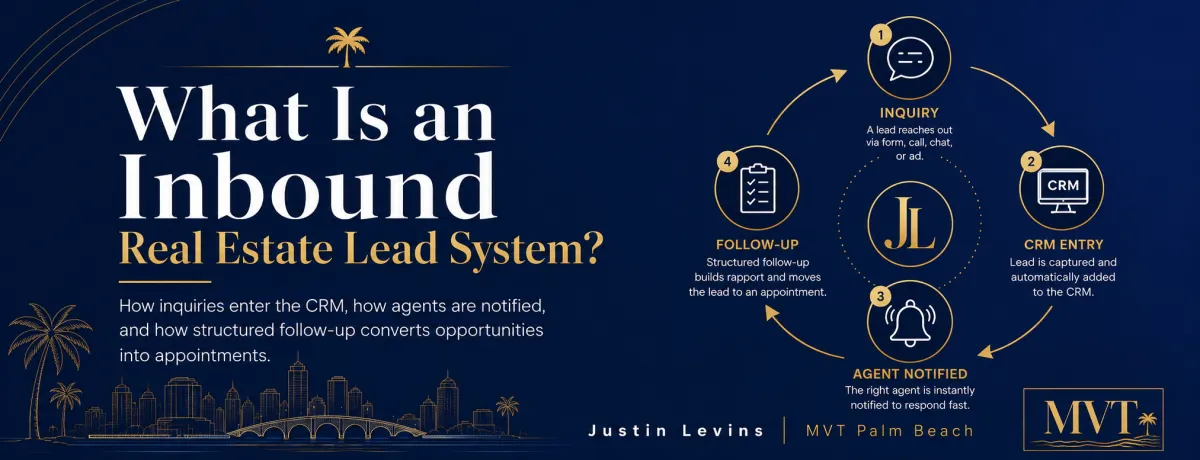
What Is an Inbound Real Estate Lead System?
After five years in real estate, one thing I have learned is that getting an inquiry is only the beginning.
A buyer fills out a form. A homeowner asks about selling. Someone responds to a listing, requests more information, or reaches out because they are thinking about making a move.
That moment creates an opportunity, but it does not automatically create an appointment.
The difference often comes down to what happens next.
I’m Justin Levins, MVT Palm Beach Team Leader, and I work with buyers, sellers, investors, and families throughout the Palm Beach area. I have also spent a lot of time thinking about how agents can create a more consistent business without allowing good opportunities to disappear because of slow responses or inconsistent follow-up.
That is where an inbound real estate lead system comes in.
What Does “Inbound Lead System” Actually Mean?
An inbound real estate lead system is simply a structured process for handling people who have already shown some level of interest in real estate.
They may have:
Asked about a property
Requested a home valuation
Submitted information through a website
Replied to an advertisement
Called about buying or selling
Reached out through social media
Requested information about a neighborhood
Asked about financing or the home-buying process
Instead of relying on an agent to remember every inquiry, write notes on a piece of paper, or scroll through old text messages, an inbound lead system gives those opportunities an organized path.
Typically, that path involves three major steps:
The inquiry enters the CRM.
The agent is notified.
The agent follows a structured process designed to move the conversation toward an appointment when appropriate.
None of those steps are especially complicated by themselves. The power comes from having them work together consistently.
Step One: The Inquiry Enters the CRM
A CRM, or customer relationship management system, is where agents can organize contacts, conversations, notes, tasks, and follow-up activity.
When someone makes an inquiry through a connected lead source, their information can be entered into the CRM so the agent has one place to manage the relationship.
That matters because real estate conversations rarely happen in a straight line.
Someone might be ready to buy this week.
Another person may be six months away.
A homeowner may want to sell but still needs time to prepare the property.
A first-time homebuyer may have questions before they are comfortable taking the next step.
As someone who works with many first-time buyers, I see how important this is. People do not always enter a conversation knowing exactly what they need. Sometimes they simply want someone who can help them understand the process.
The CRM gives the agent a place to keep track of that journey.
Instead of treating every inquiry as a one-time interaction, the agent can build a history of the relationship.
What did the person ask about?
What are they trying to accomplish?
When should you follow up?
Did they mention a timeline?
Are they interested in a primary residence, an investment, a vacation property, or something else?
Those details help make future conversations more useful and personal.
Step Two: The Agent Is Notified
Once an inquiry enters the system, speed matters.
Someone who raises their hand today may speak with several real estate professionals before the day is over.
That does not mean agents should pressure people or immediately launch into a sales pitch.
It means the inquiry should not sit unnoticed.
A well-organized inbound system alerts the appropriate agent that someone has reached out so the agent can respond as soon as reasonably possible.
The first goal is not to “close the lead.”
The goal is to start a real conversation.
That distinction matters.
An agent who responds with curiosity and helpfulness can begin learning what the person actually needs.
For example:
“What caught your attention about this property?”
“Are you already working with an agent?”
“What are you hoping to accomplish with your move?”
“How soon are you thinking about buying?”
“Is this going to be a primary home, investment property, or vacation property?”
Questions like these give the conversation direction without making it feel like an interrogation.
They also help the agent determine what the next step should be.
Step Three: Structured Follow-Up Begins
This is where many opportunities are won or lost.
Agents often assume that if someone does not respond immediately, they are not serious.
That is not always the case.
People are busy.
They may be at work.
They may be talking with a spouse.
They may be researching neighborhoods.
They may be waiting until they understand their finances.
They may simply have forgotten to respond.
Structured follow-up helps agents stay present without depending on memory.
That could mean a planned sequence of calls, texts, emails, reminders, and future check-ins based on where the person is in their real estate journey.
The important word is structured.
Randomly reaching out whenever you remember someone is not a system.
A system gives you a process.
For example, an agent may attempt an initial conversation, follow up later if there is no response, provide useful information when appropriate, and schedule another task for the future.
The exact approach can vary based on the individual, but the principle stays the same: every legitimate inquiry deserves organized attention.
Follow-Up Should Add Value
One of the biggest mistakes agents can make is turning follow-up into a repeated version of:
“Just checking in.”
That becomes easy to ignore.
Useful follow-up gives people a reason to continue the conversation.
If someone is a first-time buyer, you might help explain the next step in the buying process.
If someone is interested in an investment property, the conversation may focus on what they are trying to accomplish with that investment.
If someone is exploring a vacation or short-term rental property, you may need to understand how they plan to use the property before discussing possible options.
If a seller is thinking about listing, they may need guidance on timing, preparation, or what they should consider before putting the home on the market.
The purpose of follow-up is not to chase people.
It is to remain useful while helping them move toward a decision.
From Conversation to Appointment
An appointment should feel like the natural next step of a productive conversation.
If a buyer is ready to discuss their goals in detail, it may make sense to schedule a buyer consultation.
If a homeowner is considering selling, the next step might be a conversation about their property and goals.
If an investor has specific criteria, an appointment may give you the opportunity to understand those criteria more clearly.
The system helps make sure that promising conversations do not get lost before reaching that point.
But the agent still has to do the human part.
Technology can organize the inquiry.
The CRM can remind you to follow up.
Notifications can tell you someone has reached out.
What turns that opportunity into a relationship is the quality of the conversation.
Consistency Is More Valuable Than a Perfect Script
I think agents sometimes spend too much time looking for the perfect text message, perfect script, or perfect follow-up line.
Those things can help, but consistency matters more.
Did you respond?
Did you listen?
Did you record useful information?
Did you follow up when you said you would?
Did you provide something helpful?
Did you make the next step clear?
A simple process followed consistently is usually more useful than a complicated process that nobody actually follows.
This is especially important as an agent's business grows.
When you only have a few active conversations, keeping everything in your head might seem manageable.
As the number of buyers, sellers, past clients, prospects, and referrals increases, that becomes harder.
Systems help create organization.
And organization gives agents more room to focus on the people they are serving.
The Bigger Lesson for Real Estate Agents
An inbound lead system is not really about software.
It is about being prepared when someone asks for help.
The CRM creates organization.
Notifications create awareness.
Structured follow-up creates consistency.
Good conversations create trust.
And when the timing is right, those conversations can lead naturally to appointments.
For agents trying to build a more consistent business, this is worth paying attention to.
You do not need to treat every inquiry like an emergency, and you should never make people feel pressured.
But you should have a clear answer to this question:
What happens when someone raises their hand and says they may need a real estate professional?
If the answer depends entirely on whether you happen to see the message, remember the person's name, or think about following up later, there is probably room to improve the system.
Real estate is a relationship business, but strong relationships are easier to build when there is structure behind them.
If you're an agent thinking about how to create better follow-up habits, stronger systems, and a more organized approach to your business, I'd be happy to have that conversation.
Sometimes the next stage of growth starts with making sure good opportunities are no longer slipping through the cracks.