
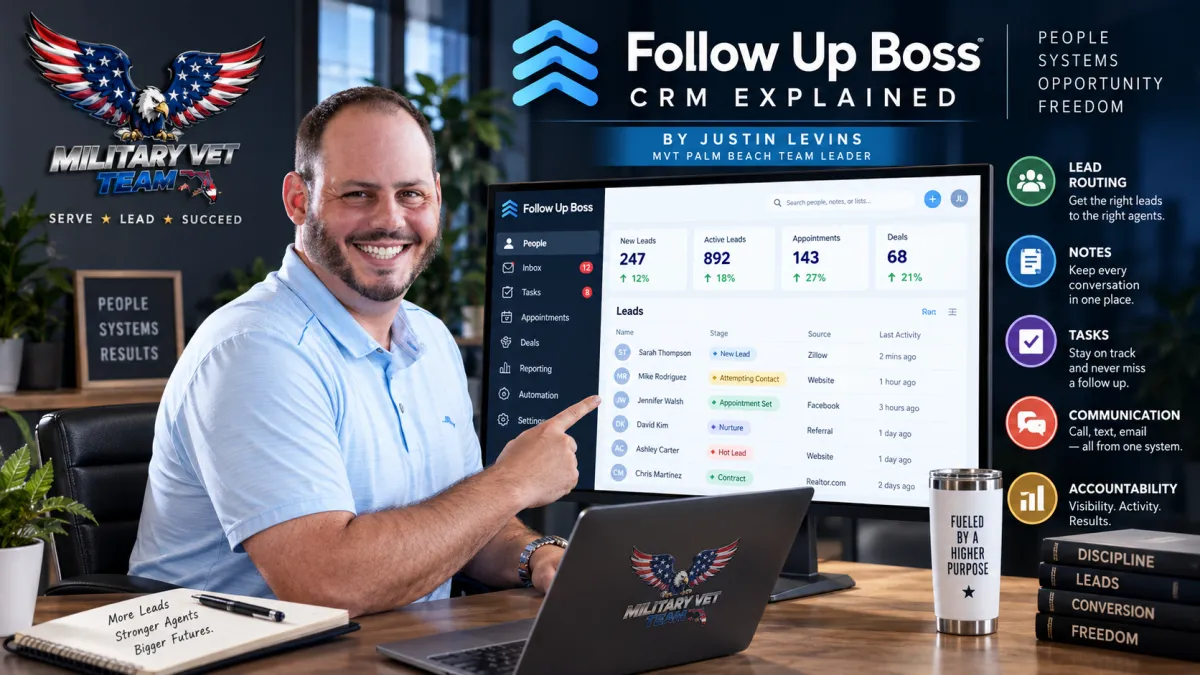
Why Follow Up Boss Is the Center of MVT’s Lead Operations, and Why That Matters More Than Agents Think
A newer agent on our team asked me a simple question after training this week.
“Justin, why does everything have to be in Follow Up Boss?”
I smiled because I remember being on the other side of that question.
When you’re new, you think the system is there to make your life harder. Another login. Another note to write. Another task to mark complete. Another place to check after a call.
Then you lose track of one buyer.
Or you forget who spoke to a seller.
Or a lead comes in from West Palm Beach, sits too long, and by the time somebody follows up, they’ve already scheduled with another agent.
That’s when you understand.
Follow Up Boss is not busywork. It is the center of lead operations for a real estate team that takes follow-up seriously.
And I want to say this clearly because I’ve heard people describe it wrong.
Follow Up Boss, or FUB, is a real estate CRM. It is not a recruiting CMS. It is not a website builder. It is not a content calendar. Follow Up Boss describes itself as a real estate CRM that brings online leads into one system and helps make sure they get followed up quickly. It also says it is not a real estate lead provider or website company.
That distinction matters.
At MVT, the work inside FUB is about lead routing, communication, notes, tasks, accountability, and making sure real people do not disappear inside a messy process.
What Is Follow Up Boss Actually Used for at MVT?
Follow Up Boss is used as the real estate CRM where lead activity, agent communication, follow-up tasks, notes, and accountability live together. It helps us keep the client journey organized from first inquiry to active conversation to appointment and beyond.
That sounds simple, but simple is powerful when a team starts growing.
A lead can come in from a website, a portal, an inquiry, a past database touch, or another source. If that lead is not captured, assigned, contacted, updated, and tracked, the opportunity can fall apart fast.
I’ve seen it happen in real estate.
Not just at MVT. In the industry in general.
One agent says, “I thought somebody else had it.” Another says, “I called, but I forgot to log it.” Another says, “They weren’t ready yet.” Then, three weeks later, that same person is under contract with someone else.
That’s not a lead problem.
That’s an operations problem.
FUB gives the team one place to see who the lead is, where they came from, what they asked about, who is assigned, what communication happened, what notes were entered, and what follow-up needs to happen next. Follow Up Boss says a lead profile centralizes contact information, communication, appointments, deals, and activity in one place.
That is why I push agents to use it correctly.
Not because I like software.
Because families deserve organized follow-up.
Why Is FUB a CRM and Not a Recruiting CMS?
FUB is a CRM because it manages real estate relationships, leads, communication, tasks, and client activity. A recruiting CMS would manage recruiting content, candidate pipelines, or recruiting pages, and that is not what FUB is built to do.
This is important for MVT because we do have recruiting, training, marketing, onboarding, and agent development happening across the organization.
But those are not all the same system.
When I talk about Follow Up Boss, I’m talking about buyer leads, seller leads, client communication, follow-up accountability, and agent activity. I’m talking about a Palm Beach buyer who clicked on a listing. A veteran family asking about VA loan options in West Palm Beach. A seller in Lake Worth Beach who wants to know what their home may be worth. A relocation lead looking near Jupiter, Wellington, or Palm Beach Gardens.
Those people belong in a real estate CRM.
Not a recruiting tool.
That clarity protects the process.
If an agent thinks FUB is just another place where the company stores random contacts, they won’t treat it with urgency. If they understand it as the operating center for client follow-up, they start seeing every note, task, and call log differently.
I grew up around real estate, long before I had a license. I watched my family handle open houses, contracts, buyer calls, and closing table stress. Back then, a lot of follow-up lived in notebooks, calendars, and memory.
Memory is not a system.
A team cannot scale on “I think I called them.”
How Does Lead Routing Work Inside a Healthy Real Estate Team?
Lead routing works by making sure the right lead gets to the right agent quickly, based on source, type, market, team structure, or other rules the business sets. The goal is not just assignment, it is speed, clarity, and ownership.
Follow Up Boss explains that teams can set up routing rules by lead source or type, keep communication in one place, and track activity and notes.
That is the backbone of real estate lead operations.
If a lead comes in asking about a home in West Palm Beach, the team needs to know who is responsible. If a seller inquiry comes in from Boynton Beach, someone should not have to dig through five chats to figure out who has it. If a military family is relocating into Palm Beach County and asking about VA financing, that lead needs fast, knowledgeable follow-up.
Lead routing does not replace relationships.
It protects them.
The first few minutes after a lead raises their hand can matter. If we are slow, confused, or unclear, the client feels it. They may not say, “Your CRM process failed.” They will just move on.
I tell agents all the time, the client does not care how busy we are.
They care that we respond.
Why Do Notes Matter So Much in Follow Up Boss?
Notes matter because they turn scattered conversations into team knowledge. A good note tells the next person what happened, what the client cares about, and what needs to happen next.
This is where I get very direct with agents.
If it is not in the notes, the team may not know it happened.
That does not mean every note has to be a novel. It means the note should be useful.
Bad note: “Called.”
Better note: “Spoke with buyer. Moving from out of state in November. Wants West Palm Beach or Palm Beach Gardens. Needs 3 bedrooms, open to townhouse, concerned about HOA fee. Sending lender intro and setting follow-up for Friday.”
That second note helps the whole team.
It helps leadership. It helps an ISA. It helps another agent covering while someone is out. It helps you three weeks later when you cannot remember why this buyer paused.
I had a buyer once who mentioned on a quick call that his wife’s commute to the hospital was the real deciding factor. It would have been easy to forget because we were talking about price, bedrooms, and loan options. I wrote it down.
Two weeks later, when he started drifting toward a house that looked great but made that commute harder, I reminded him.
He stopped and said, “You remembered that?”
I did because I wrote it down.
That is not software. That is care, stored where it belongs.
How Should Agents Use Communication Inside FUB?
Agents should use FUB communication tools to keep calls, texts, emails, and follow-up history connected to the lead record. The point is to avoid scattered conversations that only live on one agent’s phone.
Follow Up Boss says its inbox lets users track calls, emails, and text messages from one place across web and mobile.
That matters because real estate conversations rarely happen in one clean line.
A buyer texts at lunch. Then emails a pre-approval letter. Then calls from the car after seeing a listing. Then their spouse replies from a different number. Then an agent leaves a voicemail. Then somebody updates the search.
If that history is scattered, the process gets messy.
Inside a strong CRM rhythm, communication creates context. You can see when the last call happened. You can see what was said. You can see if the client has gone cold, or if they are actually waiting on us.
That is accountability.
Not in a harsh way. In a healthy way.
I do not want agents guessing. I want them reading the story of the lead and making the next right move.
Why Are Tasks So Important for Lead Accountability?
Tasks are important because they turn good intentions into scheduled action. A lead without a next task can easily become a forgotten opportunity.
Follow Up Boss says tasks can be added to a lead profile, assigned to a user, dated, timed, and displayed on the tasks page and calendar.
That is huge.
Real estate agents are busy. We are showing homes, writing offers, solving inspection issues, checking on lenders, answering sellers, helping renters, mentoring agents, and dealing with life.
Nobody remembers everything.
A task is how we tell the future version of ourselves what matters.
Call this buyer Friday. Check in after lender review. Send listings in Royal Palm Beach. Ask seller about timing. Follow up after open house. Confirm appointment. Revisit in 30 days. Touch base after PCS orders are finalized.
That rhythm is what separates a lead database from a lead operation.
A database holds names.
An operation moves people forward.
I had an agent on the team who was frustrated because a lead “went cold.” We opened the record and looked at the activity. There was one call, one text, no real note, and no next task.
That lead did not go cold.
The process did.
That is a hard truth, but it is a helpful one.
How Does FUB Help Team Leaders Coach Agents Better?
FUB helps team leaders coach agents by showing activity, response patterns, communication history, tasks, notes, and lead status. It gives leaders a clearer picture of what is happening instead of relying only on what someone says happened.
This is one of the reasons I care about FUB as a Palm Beach Team Leader.
I do not want to mentor from emotion.
I want to mentor from facts.
If an agent says, “I’m following up,” we can look together. How many touches? What kind of touches? Was there a call? Was there a text? Was there a note? Was a task set? Did the lead respond? Did we adjust the approach?
That does not need to feel like punishment.
Good accountability should feel like support.
When I coach a newer agent, I’m not trying to catch them doing something wrong. I’m trying to help them build habits that create results. Most agents do not fail because they do not care. They fail because their day gets loud and their system gets weak.
FUB gives us a place to strengthen the system.
That is how we serve more families.
That is also how we protect agents from living in chaos.
What Happens When Agents Do Not Use FUB Correctly?
When agents do not use FUB correctly, leads get missed, communication gets scattered, follow-up becomes random, and leadership loses visibility. The client experience gets weaker, even if the agent had good intentions.
This is where I have to be honest.
Real estate rewards speed, but it also rewards consistency.
You might be great on the phone. You might know the market. You might care deeply. But if you do not log notes, set tasks, update stages, and keep communication clean, the team cannot operate at its best.
A buyer in Jupiter should not be forgotten because an agent got busy.
A seller in Lake Worth Beach should not have to repeat the same story to three different people.
A veteran family moving into West Palm Beach should not be left wondering who is helping them next.
That is why systems matter.
They are not there to replace heart.
They are there to protect it.
Quick FAQ: What Are Agents Asking About FUB?
Is Follow Up Boss only for online leads?
No. FUB can organize online leads, past clients, sphere contacts, and active conversations. The key is using it as the central CRM for real estate relationships, not just a bucket for internet leads.
Do I still need to write notes if I already talked to the client?
Yes. The conversation helps the client in the moment. The note helps the process after the moment passes.
Is FUB the same as a marketing or recruiting system?
No. FUB is a real estate CRM. It supports lead follow-up, communication, tasks, notes, routing, and accountability for client relationships.
Why Does This Matter for MVT’s Future?
This matters because MVT cannot grow on scattered follow-up. If we want to serve more buyers, sellers, veterans, military families, first-time buyers, and investors, we need clean operations behind the scenes.
The public sees the closing photo.
The family sees the keys.
The agent sees the appointment.
But behind that, there is a system.
Somebody responded. Somebody followed up. Somebody logged the note. Somebody set the task. Somebody checked the file. Somebody saw the lead was slipping and stepped in. Somebody cared enough to keep the process tight.
That is why Follow Up Boss sits at the center of MVT’s lead operations.
Not because it is fancy.
Because it keeps people from falling through the cracks.
And that is personal to me.
I’m five years licensed, and I’m still learning every week as this business changes. But I also carry a lifetime of lessons from growing up around real estate. The lesson that keeps coming back is simple. Clients remember how organized you made them feel when the pressure was high.
If you are an agent at MVT, do not treat FUB like homework.
Treat it like your client care center.
Use the notes. Set the tasks. Track the calls. Keep the record clean. Follow the routing. Ask for help when you do not understand the workflow.
That is how we build trust.
That is how we protect opportunity.
And that is how we help more families across West Palm Beach, Palm Beach County, and every market MVT serves.